The Belfast Blitz
Lessons from history for our troubled times...

Imagine learning you’re pregnant when you already have a three and a half year old, and your husband has just been diagnosed with a terrible disease. This was my grandmother’s situation 85 years ago. If this wasn’t enough, she was living in London when German bombs began falling on the city. I can’t imagine what that was like. Thinking about this during today’s troubled times makes me hope we learn the lessons of history, and galvanizes my commitment to ensure Canada is better prepared in case we don’t.
In the UK, September 15th is Battle of Britain day. In Canada, we commemorate the Battle on the third Sunday of September, honouring in particular the 112 Canadian fighter pilots who helped defend the UK during that terrible time. In hindsight, September 15th is considered a turning point where the German invasion of Britain was postponed indefinitely after a significant loss of Luftwaffe aircraft, saving Britain from conquest. It symbolizes a critical period in the war and commemorates the courage and sacrifice of the aircrews who fought. As Winston Churchill said, “never was so much owed by so many to so few.”
Of course, no one knew September 15th, 1940 was a turning point at the time. Indeed September 15th was the beginning, not the end of the “Blitz,” which killed approximately 43,000 civilians across the UK. Starting on September 7th, 1940, London faced 57 straight nights of bombing by Nazi Germany, part of a concentrated 8-month campaign against UK cities to crush civilian morale and force the country’s surrender. Nightly air raids targeting cities, killing mostly civilians is what Russia is doing to Ukraine. Thankfully, it didn’t work in London in 1940, and it isn’t working in Kyiv today.
For my grandparents, things didn’t get easier. Earlier that year, my grandfather had been in France as it fell to the Nazis. An experienced radio engineer, there’s an air of mystery surrounding why he was there at that dangerous time. What we do know is France is most likely where he contracted tuberculosis, which eventually took his life in 1949. Because of the bombing, my grandparents decided that their house in the West London Borough of Ealing was too dangerous. First they moved to Bromley in Kent, but this area too was bombed. My grandmother told me how when she went for appointments during her pregnancy, hospital staff who cared for her at one check-up were no longer alive by the next, killed in the air raids. Trying to escape the Luftwaffe, my grandfather, already sick with TB and needing surgery, moved the family to my great-grandparents’ home in Belfast, Northern Ireland.
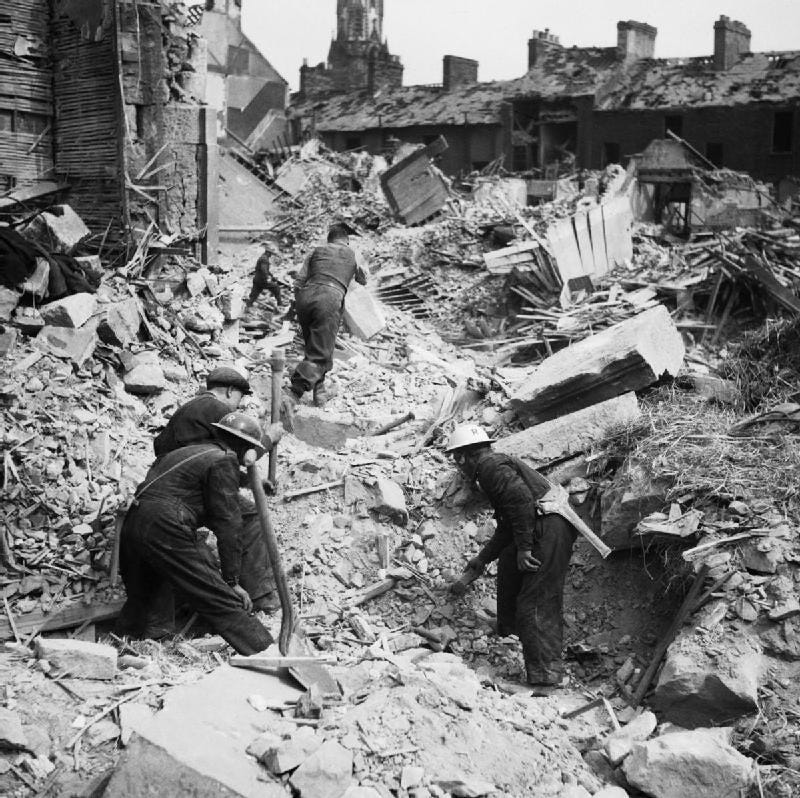
Early in the war a general complacency existed in Belfast regarding the threat of German air raids. Many people believed the city was out of range. Both the government and the public were poorly prepared. This false sense of security that the city was not a target, was tragically disproven by the “Belfast Blitz.” The Belfast Blitz consisted of four air raids on the city, between April 7th and May 6th, 1941. The first air raid was small, and likely intended to test Belfast’s air defences, which were found to be severely lacking. My mother was born on April 25th, between the 2nd and 3rd raids in a devastated city, including damage to the hospital where she was born. Some 987 people died as a result of these attacks and 1,500 were injured. 55,000 houses were damaged leaving 100,000 people homeless. The devastating air raids on Belfast were a harsh awakening, forcing a reorganization of the city's civil defence efforts. Sadly, these efforts were too late. This sort of attack on Belfast was not repeated, and the bombing raids on the UK ended on May 10th. The Battle of Britain was over.
What happened in Belfast in the Spring of 1941 is a stark reminder that just because people don’t think they’ll be attacked doesn't mean they won’t be. The best way to avoid armed conflict is to deter it. If deterrence fails, then all you can do is be prepared as best we can. Of course, preparations are only effective in advance. In today’s troubled times I hope we learn the lessons of history.